

Please read this first. This article is general information about the Oklahoma probate process. It is not legal advice or title advice. Every estate is different. Before you list, sign anything, or set a closing date, confirm the requirements for your specific estate with an Oklahoma probate attorney and the title company handling your closing.
Quick Answer: In Oklahoma, only a court-appointed personal representative can sell a house in probate. The sale follows either the regular court-supervised process, which typically includes a confirmation hearing, or a streamlined path under 58 O.S. §239 that requires written consent from the required heirs. Timelines range from about a month to a year or more, depending on the estate.
If you’re asking how does probate work for real estate in Oklahoma, you’re probably asking because someone you love has died and their house is now part of an estate. Maybe it’s your mom’s place in Broken Arrow, or the Midtown Tulsa home your family gathered in for decades. You may be telling people you’re just handling the estate. Privately, it can feel like a lot more than that.
Most families in the Tulsa metro go through probate once, maybe twice, in a lifetime. That means almost no one starts out knowing the vocabulary, the order of steps, or which decisions belong to the court, the attorney, the title company, or you. Much of what you’ll find online is written for other states or written for lawyers. Neither helps much when you’re trying to understand what happens next.
This guide is meant to give you the shape of the process. You don’t need to master Oklahoma probate law. You need to know roughly what comes first, who has authority to sign, why some sales need a court hearing and others don’t, and how long it realistically takes. That’s enough to ask good questions and avoid the most common missteps.
I’m a real estate agent, not an attorney, and I’ll say that plainly throughout. My role is to help families understand the real estate side and to work alongside the probate attorney and title company who handle the legal side. If you’re feeling uncertain, or even a little guilty about thinking of the house as something to sell, that’s normal. Asking questions now protects the estate and the people in it.
At a Glance
-
- Only a court-appointed personal representative can sell a probate house in Oklahoma.
-
- Being named in a will doesn’t give anyone authority to sell on its own.
-
- Oklahoma has two main sale paths: the regular court-supervised process and the §239 consent process.
-
- The regular path usually adds a confirmation hearing after an offer is accepted.
-
- The §239 path skips confirmation but generally requires written consent from the required heirs.
-
- Realistic timelines range from about 30 days to a year or more.
-
- Your probate attorney and title company decide which steps apply to your estate.
How Does Probate Work for Real Estate in Oklahoma, Step by Step?
Probate real estate in Oklahoma follows a fairly predictable order. Someone is appointed, sale authority is established, the home is listed and sold, the court confirms the sale if required, and the closing happens with a personal representative’s deed.
Probate is the court process that settles a person’s estate after death, confirming who inherits and who has authority to act for the estate. A personal representative is the person the court appoints to manage the estate. When there’s a will, that person is often called the executor. When there isn’t, they’re usually called the administrator.
Here’s the general sequence most Tulsa families can expect:
-
- Probate is filed. For someone who lived in Tulsa County, the case is typically filed in Tulsa County District Court.
-
- A personal representative is appointed. The court issues Letters Testamentary (with a will) or Letters of Administration (without one).
-
- Sale authority is established. This happens through a court order authorizing the sale, or through the §239 consent process.
-
- The home is listed. In some estates, this can happen subject to court approval before every step is finished.
-
- An offer is accepted.
-
- The sale is confirmed, if required. Under the regular process, the court holds a confirmation hearing.
-
- Closing. The personal representative signs a personal representative’s deed, and the sale is complete.
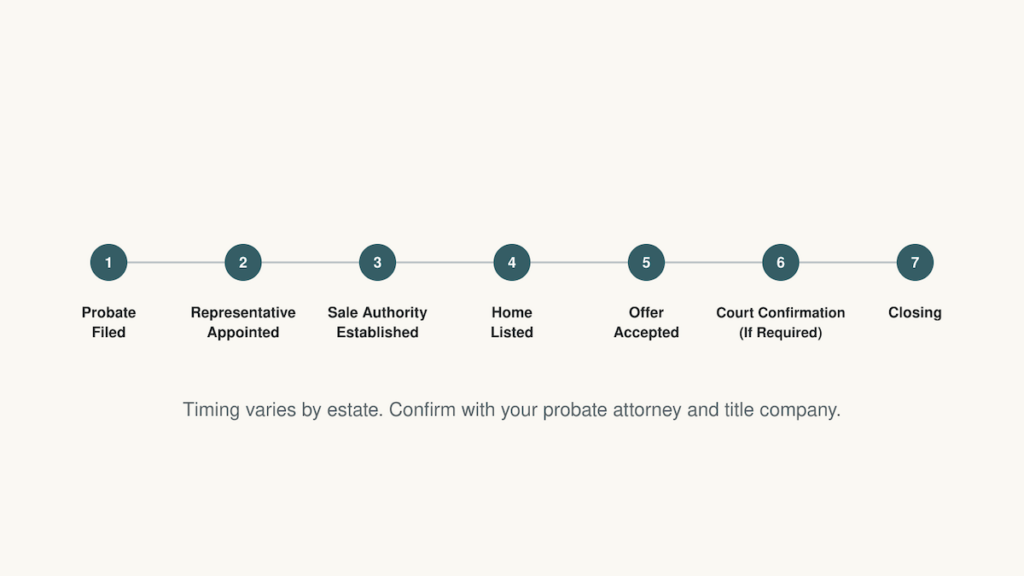
Notice that listing sits in the middle of the list, not the beginning. The steps before it are what make a sale legally possible. If you’re at the very start, What to do in your first 30 days as a Tulsa executor walks through what comes first.
Who Has the Authority to Sell a House in Probate in Oklahoma?
Only the personal representative, and only after the court formally appoints them and issues their Letters. Being named as executor in a will doesn’t grant authority to sell on its own.
This surprises a lot of families. A daughter in Jenks may have been named executor in her dad’s will years ago, and everyone assumes she can put the house on the market. Until the court admits the will and appoints her, she doesn’t have legal authority to sell estate property. The will names her. The court empowers her.
Letters Testamentary and Letters of Administration are the court documents that prove a personal representative’s authority. Title companies, lenders, and buyers’ agents will ask to see them, and they’ll want them to be current.
Once appointed, the personal representative still needs authority for the sale itself. Under the regular procedure, that generally means a court order authorizing the sale. Under 58 O.S. §239, the court can grant authority to sell without further judicial authorization or confirmation, which can save weeks. That path generally requires a judicial determination of heirs and written consent from everyone whose consent is legally required.
This is why I don’t list a probate home until the attorney and title company have confirmed who can sign and which procedure applies. Download the Executor Checklist for a step-by-step list of what to gather and who to call, at your own pace.
Do All Heirs Have to Agree to Sell a Probate House in Oklahoma?
Not always. Under the regular court-supervised process, heirs receive notice and have the right to object, but the court can authorize a sale without unanimous agreement.
The §239 path is different. It generally requires written consent from all identified heirs, devisees, and legatees whose consent is legally required. There’s a limited exception in certain cases involving a will with a residuary clause, after three months have passed with no contest. Whether that exception applies is a question for your probate attorney.
Here’s how that plays out. Picture three siblings settling their mother’s home in South Tulsa. Two are ready to sell. The third lives out of state and isn’t sure yet. Under the regular process, the court can still authorize the sale, and the third sibling has the right to be heard. Under §239, the faster path generally isn’t available unless everyone required signs on.
Disagreement among family members is common, and it’s rarely about money alone. Sometimes one person simply isn’t ready. Giving everyone clear information, proper notice, and a little time often does more to keep relationships intact than pushing for the fastest route.

Does a Probate Home Sale in Oklahoma Need Court Confirmation?
Not always. Under the regular procedure, it usually does. Under §239, it doesn’t.
In the regular process, once an offer is accepted, the personal representative files a sworn return of sale. A sworn return of sale is a filing that reports the terms of the sale to the court under oath. The court then schedules a confirmation hearing, with at least 10 days’ notice. A confirmation hearing is where the court reviews the sale and decides whether to approve it before closing.
This step typically adds two to four weeks. If there are scheduling delays, notice issues, or objections, it can add four to eight weeks or more. At the hearing, the court looks at whether the sale was fair, including whether the price was reasonable for the property. That’s one reason a probate home in Tulsa should be priced from solid comparable sales and current Tulsa market data, not guesswork or a rushed number.
Confirmation also affects which buyers are a good fit. A buyer needs to understand that the closing date depends on the court’s calendar, and a financed buyer may need a longer rate lock. Setting those expectations up front prevents a deal from falling apart in the final weeks. Selling probate property in Tulsa goes deeper on listing and negotiating.
How Long Does It Take to Sell a House in Probate in Oklahoma?
It depends on where the estate stands when you start. No one can promise a single number, but these ranges are realistic:
-
- About 30 to 60 days once a personal representative is appointed, sale authority is established, and title is clear.
-
- About 60 to 120 days if probate is filed but sale authority is still needed.
-
- Often 3 to 6 months if probate hasn’t been filed yet.
-
- 6 to 12 months or longer if there are missing heirs, family disagreement, a contested will, creditor issues, or title defects.
A home can sometimes close before the full estate is settled. Oklahoma’s creditor claim period runs at least two months after the notice to creditors is filed. Whether a sale can close during that window depends on the specific estate, the probate attorney, and the title company.
For a family in Owasso or Bixby, the honest answer to “when will this be done?” is usually “after a few specific things happen.” Knowing which of those things are still ahead is more useful than a date on a calendar. If you’d like help figuring out where your estate falls on that range, schedule a no-pressure conversation. It’s a quiet call to talk through where things stand, with no obligation.

What Paperwork Do You Need to Sell a Probate House in Oklahoma?
Before listing, the probate attorney and title company need to determine who has signing authority and which procedure applies. The paperwork follows from that decision.
Commonly required documents include:
-
- The admitted will, if there is one
-
- The order appointing the personal representative
-
- Current Letters Testamentary or Letters of Administration
-
- The order determining heirs
-
- The order authorizing the sale
-
- Written consents under §239, if that path applies
-
- A court confirmation order, unless confirmation isn’t required
-
- The personal representative’s deed
-
- Payoff information for any mortgage, tax, or lien on the property
A personal representative’s deed is the deed used to transfer property out of an estate, signed by the personal representative instead of the deceased owner. Your title company will tell you exactly what it needs to insure the sale. Tulsa executor resources can help you get organized with local contacts and tools in one place.
A home can sometimes be listed subject to court approval before every step is complete. A firm closing date shouldn’t be promised to a buyer until the estate’s attorney and title company confirm the required procedure. In the meantime, the house still needs care, especially if it’s vacant. Caring for a house during probate covers insurance, utilities, and upkeep while you wait.
By the Numbers
-
- 10 days: minimum notice before a confirmation hearing under the regular process.
-
- 2 to 4 weeks: typical time a confirmation hearing adds to a sale.
-
- 4 to 8+ weeks: what confirmation can add with scheduling issues, notice problems, or objections.
-
- 2 months: minimum creditor claim period after the notice to creditors is filed, under Oklahoma law.
-
- 3 months: the no-contest window tied to the limited §239 exception in certain will cases.
-
- 30 to 60 days: realistic sale timeline once authority is established and title is clear.
-
- 6 to 12+ months: realistic range when heirs are missing, the will is contested, or title has defects.
Frequently Asked Questions
Is it wrong to sell my parent’s house so soon?
No. Selling the house is part of caring for the estate, not a judgment on how much you loved the person who lived there.
Many executors feel guilty about moving forward, especially in the first few months. But an empty house still costs money in insurance, utilities, and upkeep, and those costs come out of the estate. You can take your time with the belongings and the memories while the legal steps move along in the background.
What if my siblings and I don’t agree about selling?
Under the regular court process, the court can authorize a sale without unanimous agreement, and every heir has the right to be heard.
Disagreement usually narrows which path is available, especially the faster §239 path. Talk with your probate attorney early about options. Clear communication and proper notice protect the estate and give family relationships the best chance of staying intact.
Can we list the house before probate is finished?
Sometimes. A home can be listed subject to court approval before every step is complete.
What shouldn’t happen is promising a buyer a firm closing date before the attorney and title company confirm the procedure. Listing early can work well, as long as everyone understands the timeline depends on the court. The rest of the selling process in Tulsa looks much like any other sale once authority is in place.
Can the house close before the estate is fully settled?
In some estates, yes. The house can sometimes close before the full estate is settled.
Oklahoma’s creditor claim period runs at least two months after the notice to creditors is filed. Whether a sale can close during that window depends on your specific estate, your probate attorney, and your title company.
Key Takeaways
-
- Confirm the personal representative has been appointed and has current Letters before talking about a listing date.
-
- Ask your probate attorney early whether the §239 consent path is possible for your estate.
-
- Expect a confirmation hearing under the regular process, and plan for two to four weeks or more.
-
- Talk with siblings and other heirs early, since consent shapes which sale path is available.
-
- Treat every timeline as a range, never a promise, until the attorney and title company confirm the procedure.
-
- Keep the house insured and maintained while the legal steps move forward.
Conclusion
Probate real estate in Oklahoma has a lot of moving parts, but the shape of it is manageable. Someone is appointed. Authority is established. The home is sold, sometimes with a court hearing and sometimes without. The attorney and title company decide which steps your estate needs, and your job is to understand the sequence well enough to ask good questions.
There’s no prize for moving fast, and there’s no shame in moving forward. Most families I work with in Tulsa find that once they understand what’s ahead, the process feels lighter. If you’d like someone on the real estate side who’ll be patient with your questions, I’m here.
Call or text me at 918-282-6385, whenever you’re ready, even if it’s just to ask where to start.
About the Author
Deborah Green is a real estate agent with Real Broker, LLC, serving buyers and sellers across Tulsa, Broken Arrow, Bixby, Jenks, and Owasso. She specializes in first-time buyers, move-up buyers, downsizers, relocation clients, and probate sales.
📞 918-282-6385 ✉️ deb@deborahsellstulsa.com
Get the free Executor Checklist
Sources & References
-
- Oklahoma Statutes, Title 58 (Probate Procedure), including 58 O.S. §§239–240, §§411–415, §§426–429, and §331, via OSCN
-
- Oklahoma State University Extension, “Probate” fact sheet, AGEC-773 (2019), general orientation to the Oklahoma probate process
-
- Tulsa County District Court, probate filings for Tulsa County residents
This article is general information, not legal or title advice. Requirements for a specific estate should be confirmed with an Oklahoma probate attorney and the closing title company.